
What, When, and How: A Pragmatic Framework for Fintech AI Execution
AI adoption in fintech has shifted from a competitive advantage to an operational baseline.
However, deploying AI within a regulated financial ecosystem presents a double-edged challenge: high risk and high complexity. A generic approach to AI integration often leads to misaligned capital, regulatory exposure, or bloated technical debt.
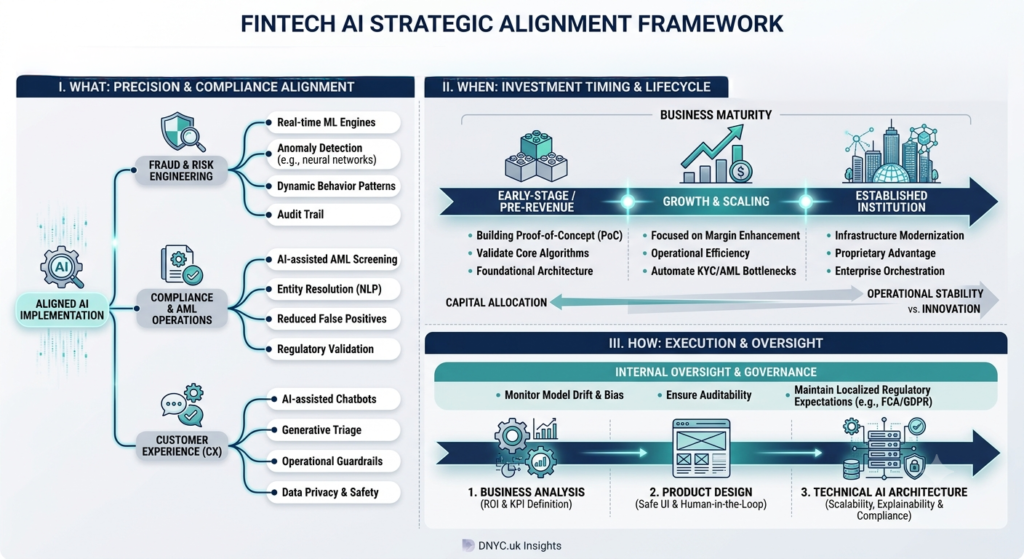
To achieve sustainable ROI and maintain regulatory alignment, fintech leadership must evaluate AI initiatives through three strategic lenses: What, When, and How.
1. WHAT: Precise Product & Regulatory Alignment
Fintechs do not deploy AI in a vacuum. Every model must solve a specific operational pain point while adhering to stringent compliance standards. Selecting the right technology depends heavily on your risk appetite and product taxonomy.
- Fraud & Risk Engineering: High-frequency, low-latency transaction monitoring requires real-time Machine Learning (ML) engines (such as gradient-boosted trees or anomaly detection neural networks). These systems flag dynamic fraudulent behavior patterns far more effectively than static rule-based systems.
- Compliance & AML Operations: Anti-Money Laundering (AML) screening benefits significantly from AI-assisted entity resolution and natural language processing (NLP). These models reduce false positives, allow compliance officers to focus on genuine risks, and create auditable decision trails.
- Customer Experience (CX): Generative AI and localized conversational agents improve triage and routine customer service. However, they must be deployed with guardrails to prevent hallucinated advice, ensure data privacy, and maintain strict adherence to consumer protection standards.
Key Executive Check: Does the proposed AI model fit your specific risk profile, and can its outputs be validated to satisfy localized regulatory obligations?
2. WHEN: Investment Timing & Lifecycle Sequencing
Investing in AI at the wrong stage of business maturity burns capital without yielding proportional returns. AI roadmaps must balance immediate margin preservation with long-term technical innovation.
Early-Stage / Pre-Revenue
└── Focus: Proof-of-Concept (PoC) & Foundational Architecture
└── Goal: Validate core algorithms and establish secure data pipelines.
Scaling Fintech
└── Focus: Margin Enhancement & Operational Efficiency
└── Goal: Automate manual bottlenecks (e.g., KYC/AML) to optimize unit economics.
Established Institution
└── Focus: Proprietary Advantage & Infrastructure Modernization
└── Goal: Deploy custom models, enterprise-wide orchestration, and real-time intelligence.
- Early-Stage & Pre-Revenue: Capital should focus on core infrastructure and light PoCs. The goal is positioning for future scalability without locking the business into premature architectural decisions.
- Scaling Fintechs: Investment must directly target operational efficiency, unit economics, and margin expansion. Automating routine compliance checks or customer interactions frees up resources to drive core growth.
- Capital Allocation: A disciplined AI roadmap sequences capital to ensure short-term operational stability remains uncompromised while systematically building long-term proprietary IP.
Key Executive Check: Are you deploying capital into AI to solve a current lifecycle constraint, or are you over-engineering for a scale you haven’t yet reached?
3. HOW: Execution, Architecture & Oversight
Strategic intent fails without cross-functional alignment. Successful AI execution bridges business analysis, product design, and deep technical architecture, ensuring that what gets built matches the business strategy and compliance controls.
Strategic Coherence across Teams
Business Analysis ──────► Product Design ──────► Technical AI Architecture
(Defines ROI & KPI) (UX & Safety UI) (Scalability & Explainability)
- Cross-Functional Alignment: Business analysts define the ROI metrics, product designers create clear UI/UX patterns (including human-in-the-loop workflows), and AI architects build secure, explainable systems.
- Internal Oversight & Governance: Teams need clear governance structures to monitor model drift, explainability, and bias.
- Regulatory Compliance: Technical architecture must accommodate localized fintech regulatory expectations (such as FCA guidelines in the UK or GDPR data handling requirements), ensuring auditability at every stage of the pipeline.
Key Executive Check: Does your execution team possess the cross-disciplinary oversight required to build models that are technically sound, commercially viable, and fully compliant?
Bridging the Gap from Strategy to Deployment
Scaling AI in fintech is not simple. It is an architectural and strategic discipline before it is a technical exercise to be outsourced. Aligning model selection with risk profile, timing investments with business maturity, and maintaining strict execution oversight ensures AI investments deliver measurable value.
Bespoke Strategy Review
At DNYC, we help fintech leaders design, sequence, and execute high-impact AI strategies tailored to regulated environments.